Lord of the Rings Filming Locations in New Zealand
A North and South Island map guide to LOTR filming locations — Hobbiton, Rivendell, Ngāuruhoe (the Mordor scenes), Edoras and Lothlórien — and which tours reach each one.
Peter Jackson filmed the entire Lord of the Rings trilogy in New Zealand, turning the country itself into Middle-earth. More than 150 locations across both islands stood in for the Shire, Rohan, Mordor and beyond — but only a handful are practical to visit, and they are spread far apart. This guide maps the key filming locations by island and explains which Lord of the Rings tours actually reach each one, so you can plan a realistic itinerary instead of an impossible one.
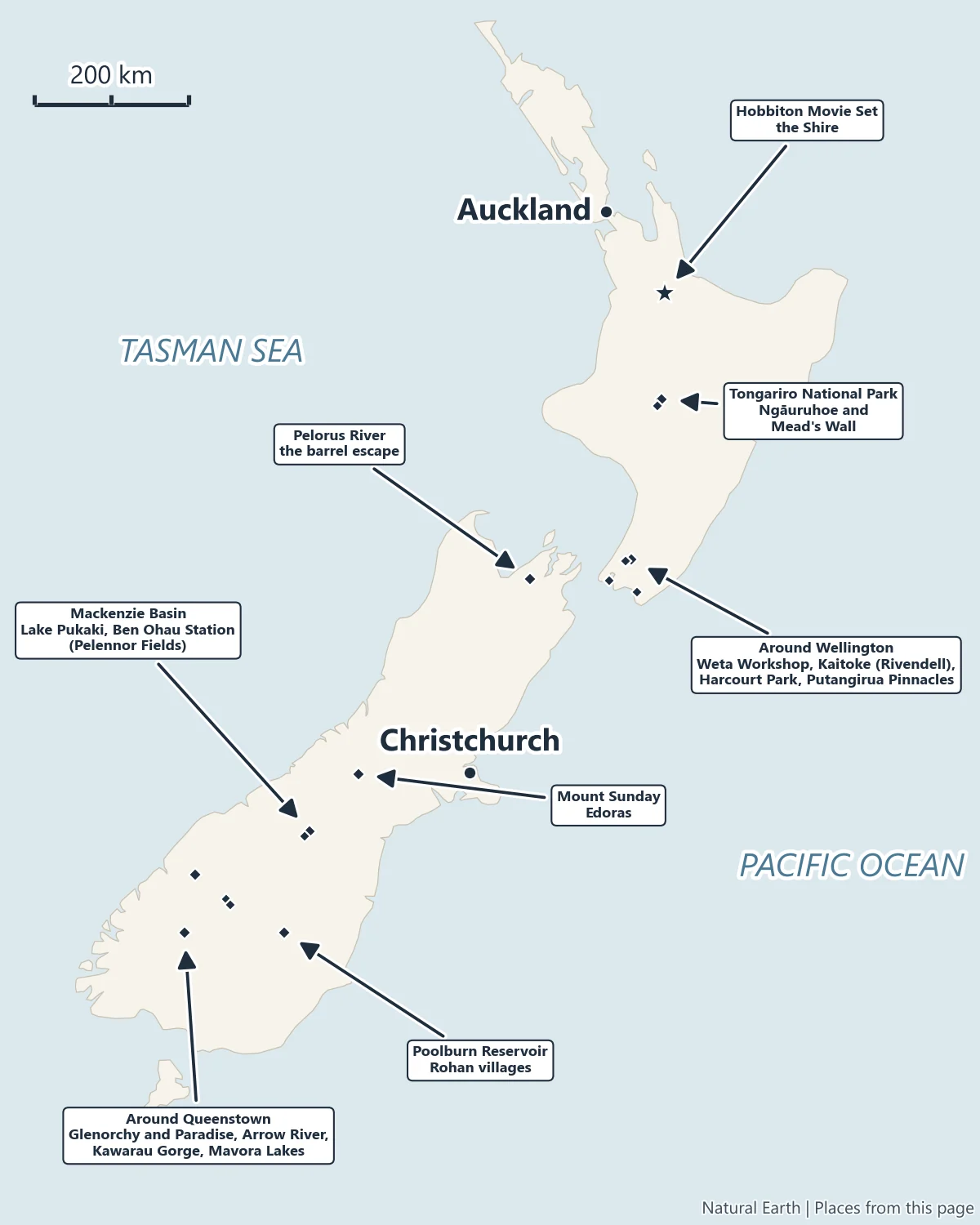
Hobbiton is the one location with its set still standing; the ticket cost US$74 on 28 October 2026, rated 4.9 from 9,031 reviews. For every pin, see the map of 16 filming locations.
North Island Filming Locations
The North Island holds the single most famous location of all — and several Wellington-area sites that fans often miss.
Hobbiton — Matamata, Waikato
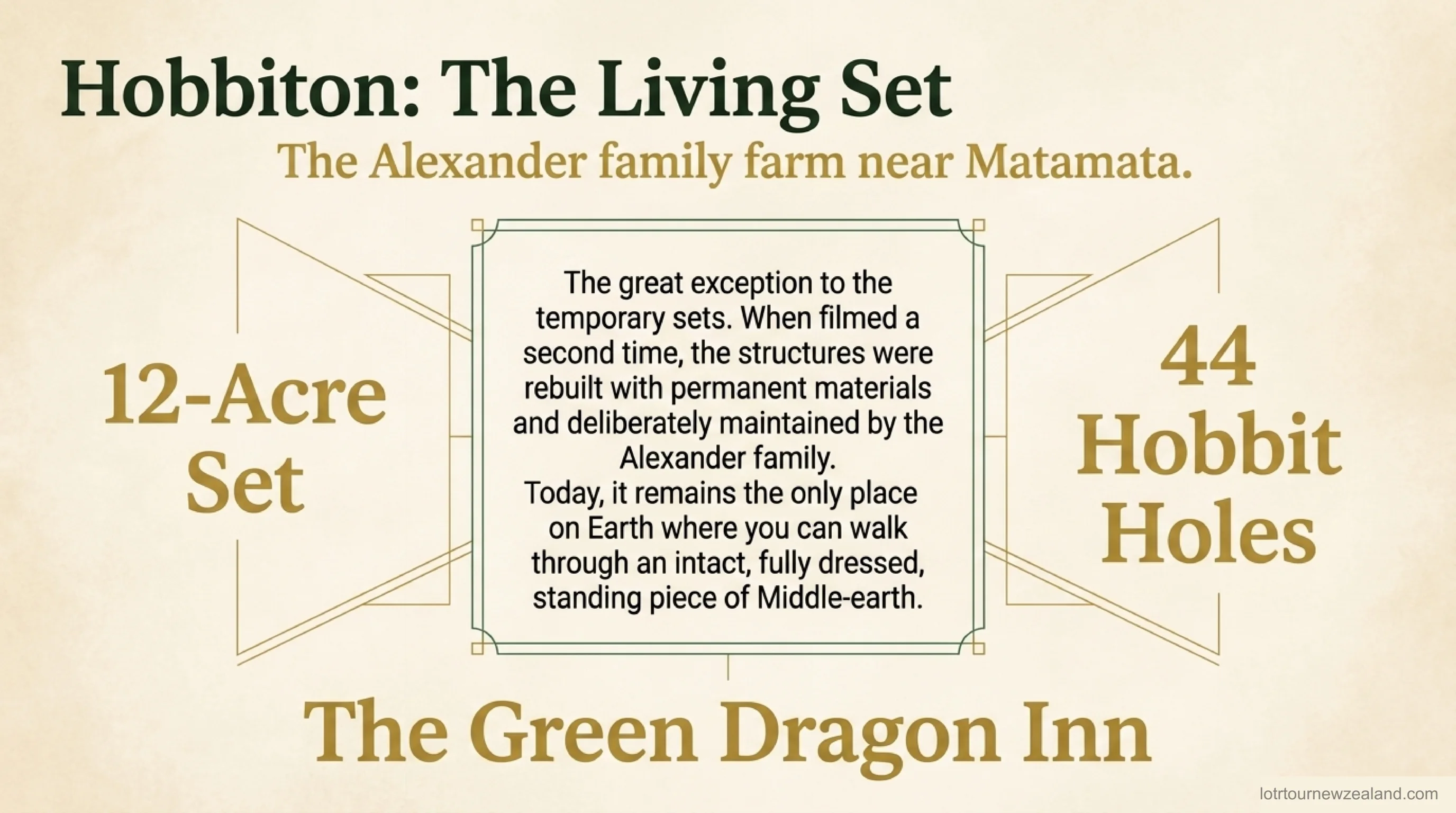
The rolling green farmland near the town of Matamata became the Shire, and the village of Hobbiton was built here. Unlike almost every other location, the set was rebuilt as a permanent attraction, so you can walk it today: the 44 hobbit holes, the Mill, the Party Tree and The Green Dragon Inn. Access is on the Hobbiton Movie Set guided tour only: the set is on farmland near Matamata, 167 km from central Auckland by road.
Wellington Region — Rivendell, Hobbiton Woods, Wētā Workshop
Wellington, New Zealand’s capital and the home base of the production, hosted numerous locations. Mount Victoria forest, right on the edge of the city, doubled as the woods of the Shire where the hobbits hide from the Black Rider. Kaitoke Regional Park, north of the city, became Rivendell, the elven refuge. Wellington is also home to Wētā Workshop, the studio that built the films’ props, armour and creatures, which runs a guided tour (from US$34, October 2026).
Tongariro National Park — Ngāuruhoe (the Mordor scenes)
In the volcanic heart of the North Island, Tongariro National Park supplied the bleak landscapes of Mordor, and the cone of Ngāuruhoe was filmed for the Mordor scenes. Tawhai Falls in the same park was the Forbidden Pool where Faramir’s men capture Gollum. The mountains are sacred to the local iwi, and the Department of Conservation asks visitors not to climb to the summits.
South Island Filming Locations
The South Island delivered the trilogy’s most dramatic alpine and high-country scenery — Rohan, Lothlórien and the great battlefields.
Edoras — Mount Sunday, Canterbury
Mount Sunday, a lone flat-topped hill rising from the braided rivers of the Rangitata Valley, became Edoras, the hilltop capital of Rohan, with the golden hall of Meduseld built on its summit. It sits in remote high country in Canterbury; the site itself is reached on foot, and the surrounding land is private. The most practical way to visit is the full-day Lord of the Rings tour to Edoras from Christchurch.
Glenorchy and Paradise — Isengard and Lothlórien
At the head of Lake Wakatipu, a scenic drive from Queenstown, the Glenorchy and Paradise areas provided the settings for Isengard and the elven realm of Lothlórien. Nearby, the Twelve Mile Delta on the Glenorchy road was used for Ithilien, where Frodo, Sam and Gollum watch the battle with the oliphaunts; the Ford of Bruinen was filmed on the Arrow River near Arrowtown. These sites are covered by the Queenstown Lord of the Rings tour to Glenorchy.
The Mackenzie Country — Pelennor Fields
Near Twizel, in the wide open Mackenzie Country, Peter Jackson staged the epic Battle of the Pelennor Fields, where the armies of Gondor and Rohan clashed with the forces of Mordor.
Locations by Island — At a Glance
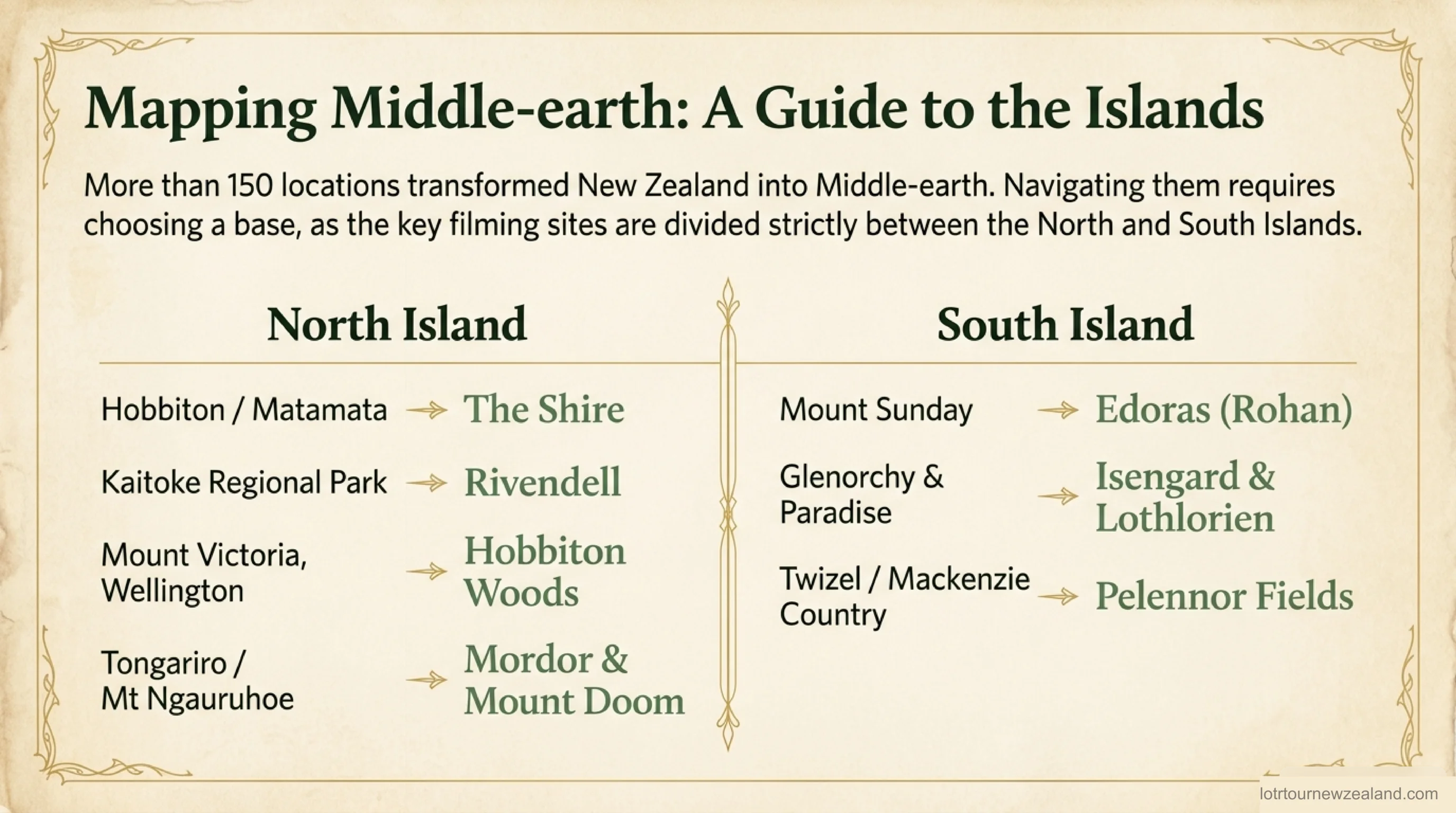
| Location | Island | Middle-earth role | How to visit |
|---|---|---|---|
| Hobbiton (Matamata) | North | The Shire | Hobbiton guided tour |
| Kaitoke Regional Park | North | Rivendell | Wellington-area tours |
| Mount Victoria, Wellington | North | Hobbiton Woods | Wellington LOTR tours |
| Tongariro / Ngāuruhoe | North | Mordor | National park tracks |
| Mount Sunday | South | Edoras (Rohan) | Edoras tour from Christchurch |
| Glenorchy & Paradise | South | Isengard, Lothlórien | Glenorchy tour from Queenstown |
| Twizel / Mackenzie Country | South | Pelennor Fields | South Island self-drive |
Why So Few Locations Are Visitable
It surprises many fans that, with more than 150 locations used across the trilogy, only a short list is realistic to visit. The reason is simple: almost every set was temporary. Film crews had a legal obligation to restore most sites to their original state once shooting wrapped, so the structures that defined Edoras, Rivendell or Helm’s Deep were dismantled. What remains in those places is the landscape — the mountain, the valley, the forest — not the built set.
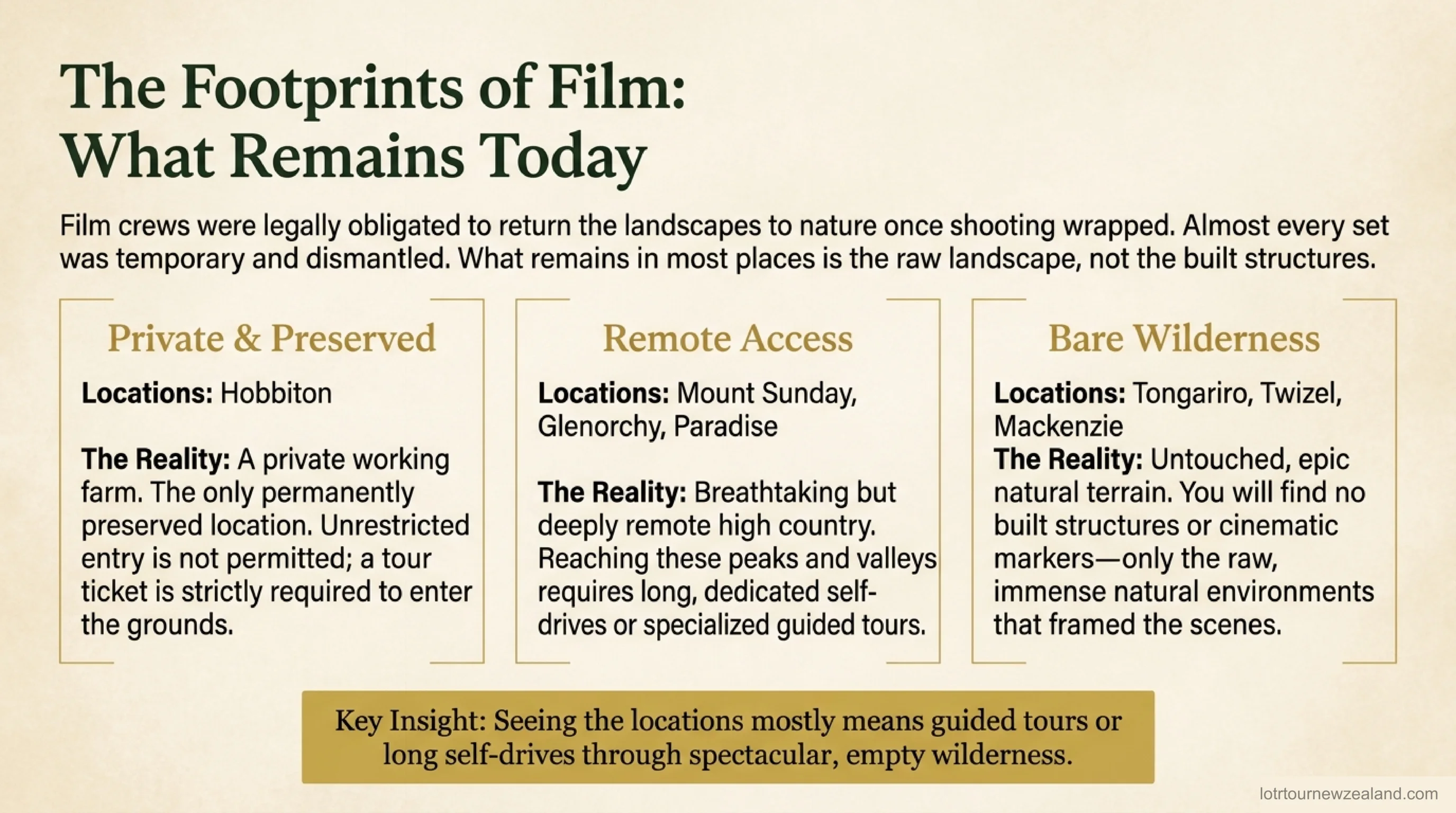
Hobbiton is the great exception. After the initial Lord of the Rings shoot the set was largely temporary, but when The Hobbit trilogy was filmed the set was rebuilt with permanent materials, and the Alexander family chose to keep it. That is why Hobbiton is the only place you can walk through an intact, dressed Middle-earth set rather than simply standing where one used to be. Everywhere else, a guide and a good imagination do the work — which is exactly what the dedicated South Island tours provide.
Planning a Realistic Itinerary
The single biggest mistake fans make is underestimating the distances. Hobbiton is on the North Island; Edoras and Glenorchy are on the South Island, separated by the Cook Strait and a domestic flight or ferry crossing. Trying to see “everything” in a few days is unrealistic. A better approach: pick one island as your base. North Island travellers can pair Hobbiton with Wētā Workshop in Wellington. South Island travellers can combine the Glenorchy tour from Queenstown with the Edoras tour from Christchurch. Each location is itself a journey, and the scenery between them is half the reward.
Ready to Book?
Of all the filming locations in New Zealand, Hobbiton is the one you can walk through. The Hobbiton Movie Set guided tour is rated 4.9 from 9,031 reviews and cost from US$74 a person on 28 October 2026, with free cancellation up to 24 hours before. Book it, then build the rest of the trip around the island you choose as your base.
